How to Find a Podcast's Producer or Booking Contact

Most podcast pitches that go nowhere had a decent idea and never reached anyone who could say yes.
Finding the right contact is the least glamorous part of podcast outreach, and it decides whether everything after it gets read. This guide shows how to do it.
Start by working out who makes the booking decision
Not every show works the same way. Before you go looking for an email address, figure out who you're looking for:
- The host books guests directly on a lot of independent and mid-sized shows. This is the most common setup for anything that isn't a large media brand.
- A producer handles booking on shows with a production team behind them. The host might not see your pitch at all until the producer has already screened it.
- A booking agency or network manages guest scheduling for shows that are part of a larger podcast network or media company. These are usually the hardest to reach directly and the most likely to have a formal submission process.
Pitching a host directly when a producer owns booking wastes your first, best shot at a reply. It's worth the extra two minutes to work out which one you're dealing with before you send anything.
Where to look
In rough order of reliability:
The show's own website. A dedicated "be a guest" or "contact" page is the strongest signal you've found the right person, because the show has explicitly told you who to reach and how.
Recent show notes. Producer and booking contact names sometimes appear in the credits of recent episodes, especially on shows with a production team.
LinkedIn. Searching for the show's name alongside "producer" or "podcast producer" turns up a name more often than people expect, particularly for shows tied to a media company or network.
The podcast's RSS feed or platform listing. Sometimes there's a contact email buried in the show's own metadata that never made it onto the website.
A general inbox, as a last resort. A hello@ or info@ address will sometimes get you through, but it's the least reliable option. It gets far more email than a direct contact does, and there's no guarantee anyone screening it is the person who books guests.
Why guessing does more damage than it saves
It's tempting to fire off a pitch to a plausible-looking email and move on, but a pitch that lands with the wrong person, or bounces outright, does damage beyond that one email. On a show with any kind of audience, a wrong or generic pitch is exactly what gets a sender mentally filed as "not worth reading next time."
If you can't confidently verify a contact, say so and move to the next show on your list instead of sending something into the void and counting it as outreach.
How to verify you've got the right person
Once you have a name and an email, a few quick checks are worth the extra minute:
- Does the name match someone credited on recent episodes, or listed on the show's own site?
- Does the email domain match the show or its production company, rather than a personal or unrelated address?
- Has this person been active recently (a recent post, a recent episode credit), or does the contact look stale?
If none of that lines up, treat the contact as unverified rather than pretending it's solid, and hold off pitching until you have a better one.
Doing this at scale
All of this is manageable for one or two shows. It stops being manageable the moment you're trying to build a target list of twenty or thirty podcasts for a campaign.
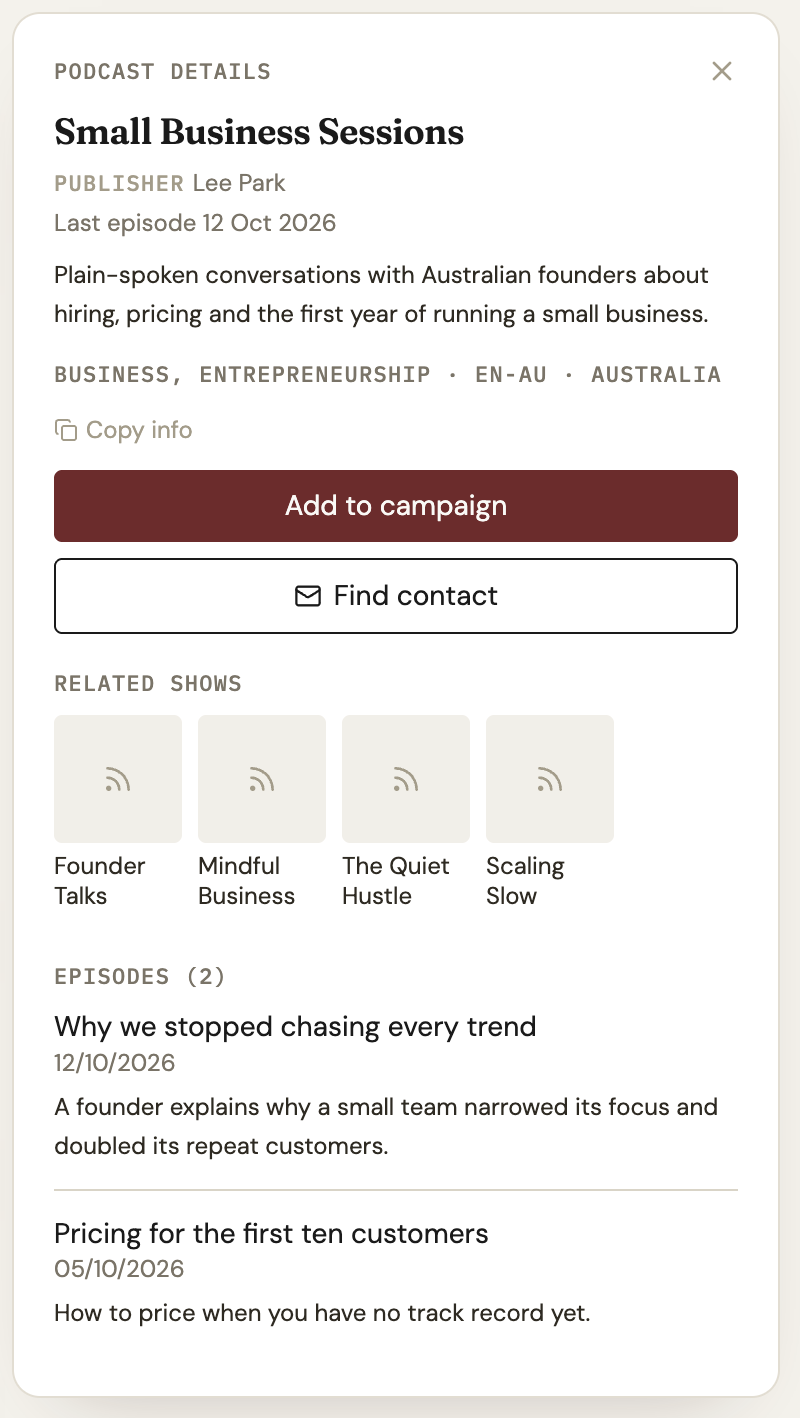
The Podcast Assistant looks up a show's contact when you ask, across a database of 4.5 million podcasts, and shows a confidence label so you can see when a contact hasn't been verified. If it can't find a reliable one, you can request further research instead of sending into the dark. That replaces an afternoon of confirming contacts by hand with research that is done before you start writing the pitch.
See it in the product
No credit card needed