How to Pitch Yourself as a Podcast Guest

A clear angle, a short pitch and a list of the right shows are enough to get booked on podcasts. Most people get stuck because they skip the angle and go straight to writing an email that says, in different words, "I'd love to be on your show."
This guide is for founders, authors, experts and anyone else pitching themselves rather than a client.
Lead with the angle
Self-pitches often go wrong in the first line, where the sender leads with who they are instead of what they'd talk about. A host doesn't need your full biography in the first paragraph. What they need, in one sentence, is the specific thing you'd bring to their show that their audience would want to hear.
Compare two openings. "I'm the founder of a SaaS company" tells a host your job title. "I spent two years figuring out why founder-led sales fails past the first ten customers, and what works instead" tells them what the episode would cover. The second is specific, so a host can picture the episode straight away and say yes. A vague pitch is easy to skim past.
Before you write any pitches, list three or four specific things you could talk about, each narrow enough to describe in a sentence. That list becomes the raw material for every pitch you send.
Match the angle to the show, every time
A pitch that could go to any podcast reads as if it went to every podcast, and hosts can tell.
Before you pitch a show, listen to a recent episode or two. Notice the format, the kind of guest they usually have on and how much detail they go into. Then choose which of your angles to lead with, and refer to something specific about the show, such as an episode you listened to or a theme they return to. Each of these shows the host you researched their show before writing.
What a good pitch contains
A pitch email can be short. It contains, in roughly this order:
- A specific, relevant reference to the show, which tells the host you listened and know what they cover
- Your angle in one or two sentences, framed around what their audience gets
- Enough credibility to make the angle believable, in a sentence
- A low-friction next step, such as offering a time or asking whether they'd like more detail
Most self-written pitches run too long because they try to make a full case for why the sender deserves a spot. The point of the pitch is to earn thirty more seconds of the host's attention.
Bring loose talking points
Once a host says yes, send a loose list of what you'll cover instead of a rigid script. Most hosts want that so they can prepare good questions, and a structured outline can turn a conversation into a recitation. Three or four topics you're comfortable going deep on will usually serve a host better than a full run sheet.
The most common ways this goes wrong
Pitching too broad. A host can't build an episode around "I can talk about entrepreneurship." Narrow it until it's specific enough to picture.
Pitching shows with a weak fit. A show that hasn't published in a year, or one whose audience has nothing to do with your topic, isn't worth the pitch however good it is. Check the show before you write to it.
No follow-up. A first email can be missed. A polite follow-up about a week later, referring back to the original pitch, gives it a second chance to be seen.
Doing this without it taking over your week
Self-pitching means finding shows, finding the right contact, writing something specific to each one and keeping track of who you've already contacted. Those tasks add up fast once you do them consistently instead of as a one-off.
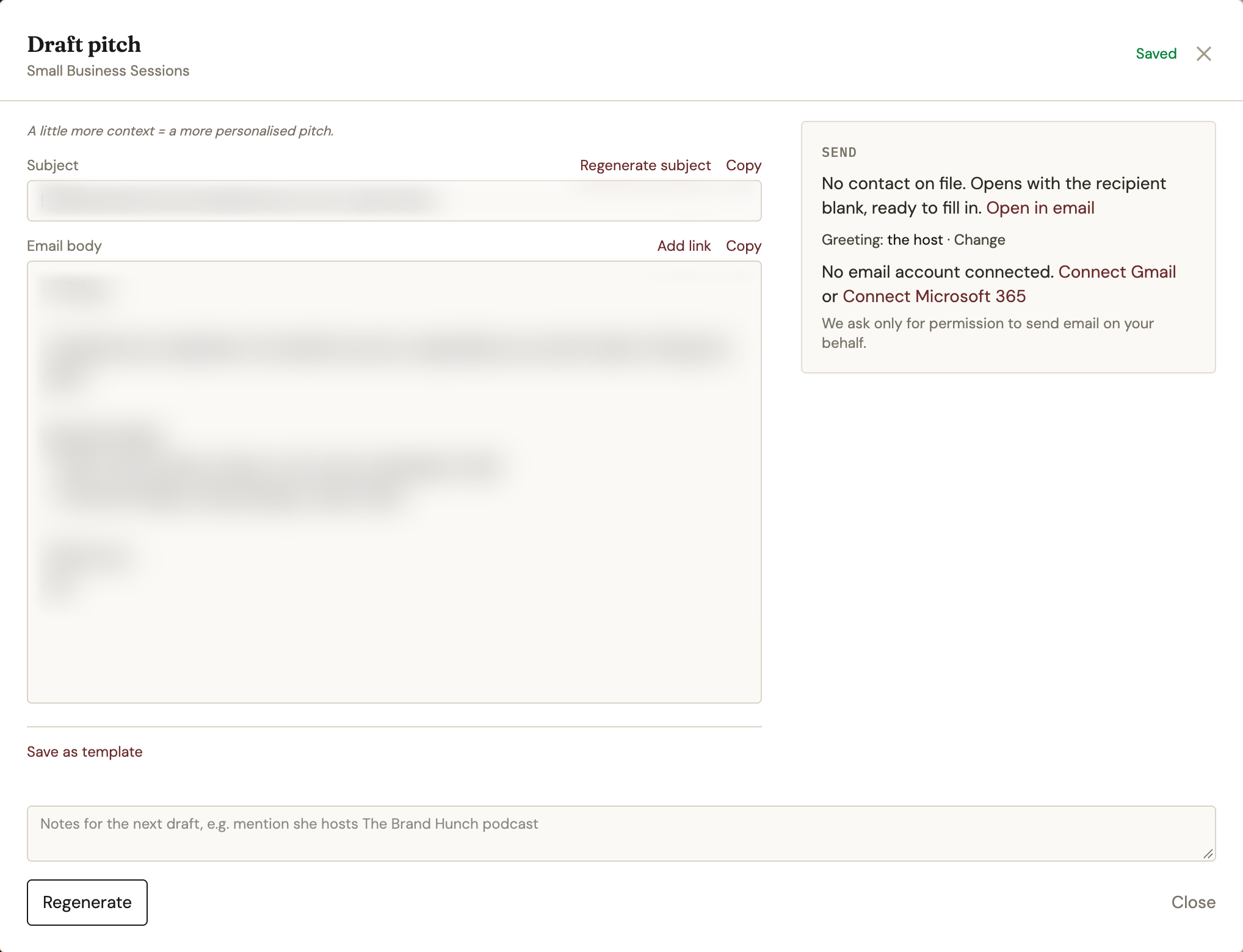
The Podcast Assistant handles the research and drafting. You search a podcast database, get a host or producer contact with a confidence label, and draft a pitch that you edit and send from your own inbox. Everything is tracked, so you can see who you've already contacted.
See it in the product
No credit card needed